Researchers Demonstrate Photo‑Induced Twisting of Moiré Superlattices in Nature Study
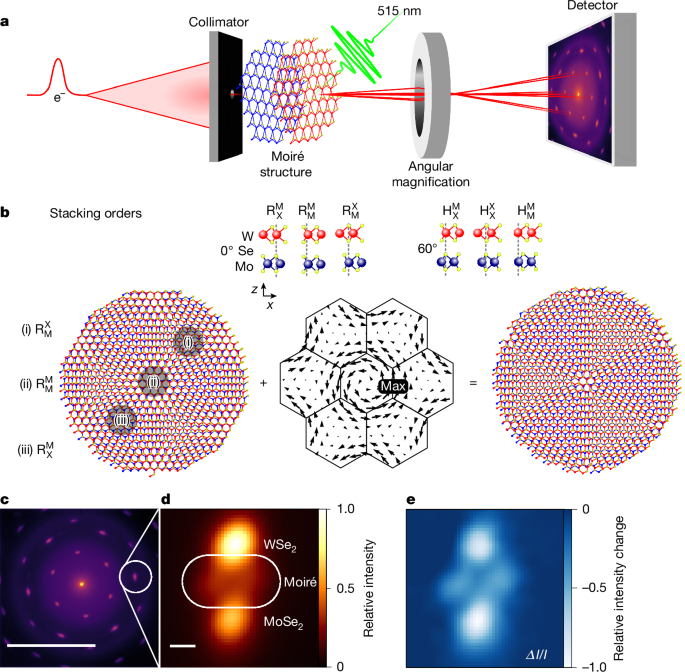
A team of physicists has reported a new method for dynamically controlling the twist angle of moiré superlattices using light, a breakthrough described in the latest issue of Nature. The technique enables reversible “twist‑and‑untwist” operations on layered two‑dimensional materials, opening pathways for on‑demand tuning of electronic properties that were previously fixed during fabrication.
Moiré superlattices arise when two atomically thin crystals, such as graphene or transition‑metal dichalcogenides, are stacked with a slight rotational misalignment. The resulting interference pattern creates a periodic potential that can dramatically alter charge carrier behavior, giving rise to phenomena like correlated insulating states and superconductivity at so‑called magic angles. Until now, the twist angle could only be set mechanically during assembly, limiting the ability to explore dynamic phase transitions.
In the reported experiments, researchers illuminated a bilayer graphene sample with ultrafast laser pulses while monitoring its structural response with electron diffraction. The photon‑induced torque caused the layers to rotate by a fraction of a degree, effectively shifting the system between distinct moiré configurations. Importantly, the process was fully reversible: subsequent pulses restored the original alignment, demonstrating controllable, repeatable modulation of the lattice geometry.
Scientists familiar with the field said the work provides a practical route to study how electronic phases evolve under continuous angle variation. “The ability to photo‑control the twist adds a powerful knob for probing correlated states without rebuilding the device,” a condensed‑matter theorist commented in a generic statement. Industry analysts also noted potential applications in tunable optoelectronic devices, where dynamic adjustment of band structures could improve performance of photodetectors and modulators.
The authors caution that the technique currently operates under low‑temperature and vacuum conditions, and scaling it to ambient environments will require further engineering. Nonetheless, the study establishes a proof‑of‑concept that could inspire a new class of reconfigurable quantum materials. Future research is expected to explore other material combinations and to integrate the approach with existing photonic platforms, potentially leading to adaptive electronic systems that respond in real time to optical signals.