Record-Breaking Flare from Distant Black Hole Emits Light Equivalent to 10 Trillion Suns
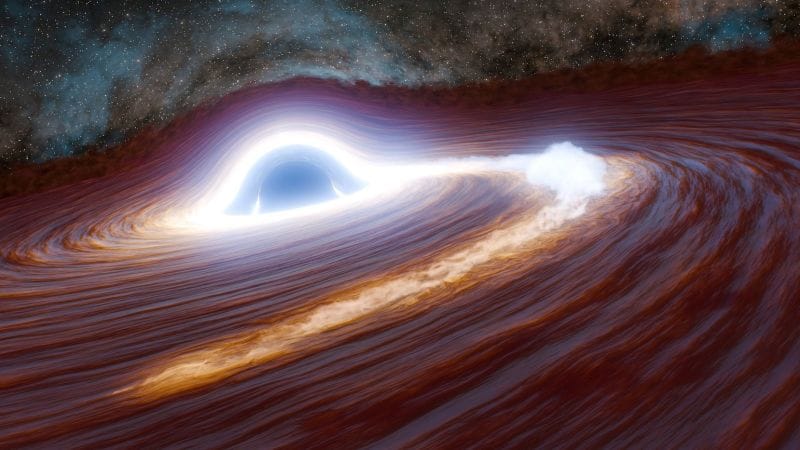
A multinational team of astronomers announced the detection of the most powerful and distant flare ever recorded from a supermassive black hole. Nicknamed “Superman,” the outburst originated in a galaxy roughly 10 billion light‑years away and briefly radiated an energy output comparable to the combined light of 10 trillion suns.
The flare was first identified by an array of space‑based observatories monitoring high‑energy radiation across the electromagnetic spectrum. Data from X‑ray, ultraviolet and infrared instruments showed a rapid rise in brightness that peaked within a few hours before gradually subsiding over several days. Follow‑up observations confirmed the event’s distance using spectroscopic redshift measurements, placing it among the most remote phenomena of its kind ever observed.
Supermassive black holes are known to produce flares when material from their surrounding accretion disks spirals inward and is heated to extreme temperatures. However, the sheer scale of the “Superman” flare exceeds previous records by an order of magnitude. Experts suggest that a sudden influx of gas—potentially triggered by the merger of two galaxies—could have supplied the black hole with an unusually large amount of fuel, leading to the extraordinary release of energy.
The discovery provides valuable insight into the behavior of black holes in the early universe, when such objects were more actively growing. By comparing this event with earlier, less luminous flares, researchers hope to refine models of black‑hole accretion dynamics and better understand the role these eruptions play in shaping their host galaxies. Ongoing monitoring campaigns are planned to capture any subsequent activity from the same source, while theoretical work will aim to explain how such a massive energy release can be sustained without disrupting the surrounding galactic environment.
While the flare poses no direct threat to Earth, its observation underscores the capabilities of modern astronomical instrumentation and international collaboration. The data gathered will be archived for future analysis, contributing to a growing catalog of extreme cosmic events that help scientists probe the fundamental physics governing the universe.