Record-Breaking Black Hole Flare Outshines 10 Trillion Suns, Scientists Say
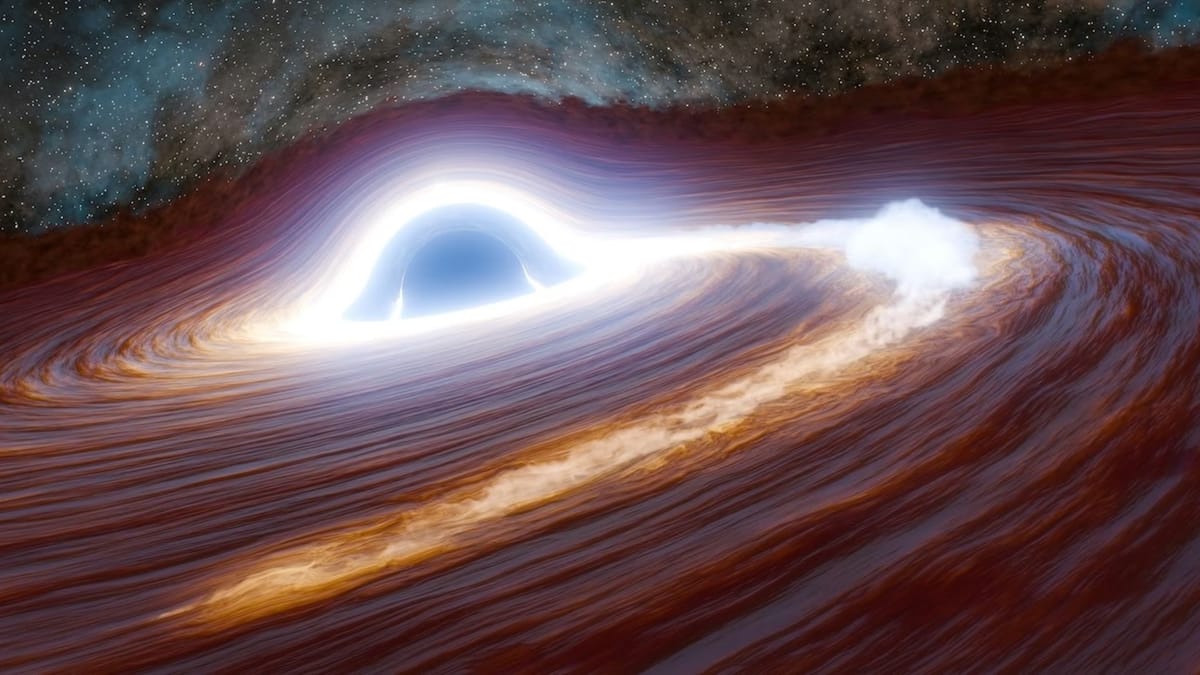
A supermassive black hole in a galaxy located several billion light‑years from Earth has produced a flare so intense that its brightness exceeds that of 10 trillion suns, making it the most luminous event of its kind ever recorded.
The outburst was first detected by a network of space‑based X‑ray telescopes and confirmed by ground‑based optical surveys coordinated through the International Transient Survey. The instruments measured a sudden rise in radiation lasting several weeks, with peak luminosity estimated at more than 10^48 erg s⁻¹. This level of output dwarfs the combined emission of typical galaxies and places the event at the extreme upper end of known tidal‑disruption phenomena.
Scientists believe the flare resulted from a tidal disruption event, in which a star roughly 30 times the mass of the Sun ventured too close to the black hole’s event horizon. The star was torn apart by gravitational forces, and its debris formed a rapidly accreting disk that radiated enormous amounts of energy before being swallowed. The disruption unfolded over a period of days, after which the luminosity peaked and began a gradual decline.
While tidal disruption events have been observed before, this instance stands out for its unprecedented brightness and the apparent size of the disrupted star. Researchers note that such powerful eruptions provide a unique laboratory for studying the physics of accretion, relativistic jet formation, and the growth of supermassive black holes in the early universe. Comparisons with earlier, less energetic events suggest that the mass of the victim star and the spin of the black hole are key factors in determining flare intensity, and the observations also shed light on how black holes may regulate star formation in their host galaxies.
Follow‑up observations are planned with a suite of high‑energy observatories to track the decline of the emission and to search for any lingering jets or afterglow. The astronomical community has highlighted the need for more continuous monitoring to capture such fleeting phenomena, and the data will help refine theoretical models and inform future surveys aimed at catching similar cataclysmic episodes, which are critical for understanding how black holes influence their cosmic environments.