Interstellar Comet 3I/ATLAS Shows Unexpected Acceleration and Blue Hue Near the Sun
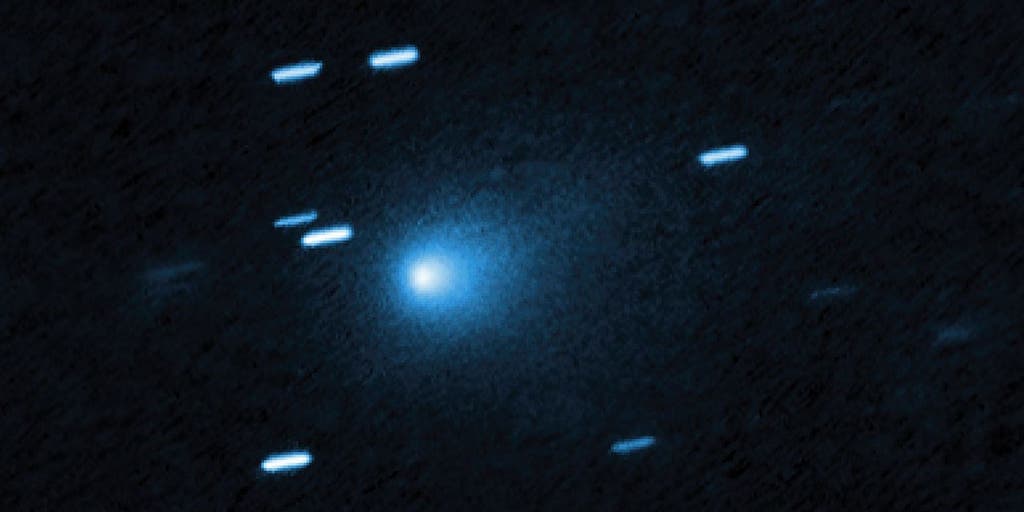
Scientists monitoring the interstellar comet 3I/ATLAS have reported that the object, which entered the inner solar system earlier this summer, began to accelerate in a manner not fully explained by gravity alone and developed a noticeable blue coloration as it approached the Sun.
The comet was first detected by an automated sky survey in July, prompting a series of observations from ground‑based telescopes and space‑based instruments. Initial trajectory calculations indicated a hyperbolic path typical of objects originating outside the solar system. Over the past weeks, however, precise astrometric data revealed a slight deviation from the expected orbit, a phenomenon described by researchers as “non‑gravitational acceleration.”
Experts suggest that the most plausible explanation for this acceleration is outgassing – the release of volatile materials as the comet’s icy nucleus warms. When solar radiation heats the surface, sublimating gases can produce a reactive thrust that subtly alters the comet’s speed and direction. The blue tint observed in the comet’s coma is consistent with scattering of sunlight by fine dust particles and possibly by specific gas emissions, such as those from cyanogen or other carbon‑based compounds, which are known to reflect shorter wavelengths.
While 3I/ATLAS is only the second confirmed interstellar visitor after the 2017 detection of ‘Oumuamua, its behavior offers valuable comparative data. Researchers note that ‘Oumuamua displayed an even more pronounced acceleration without a visible coma, leading to a range of hypotheses about its composition. The current observations of 3I/ATLAS, featuring both acceleration and a visible blue coma, support the view that many interstellar objects may share common icy, volatile‑rich characteristics.
Observatories will continue to track 3I/ATLAS as it recedes from the Sun, aiming to refine models of its trajectory and composition. The findings are expected to inform future studies of interstellar material and could improve predictions for similar objects that may intersect Earth’s orbit in the coming decades.