Interstellar Comet 3I/ATLAS Makes Close Pass by Earth
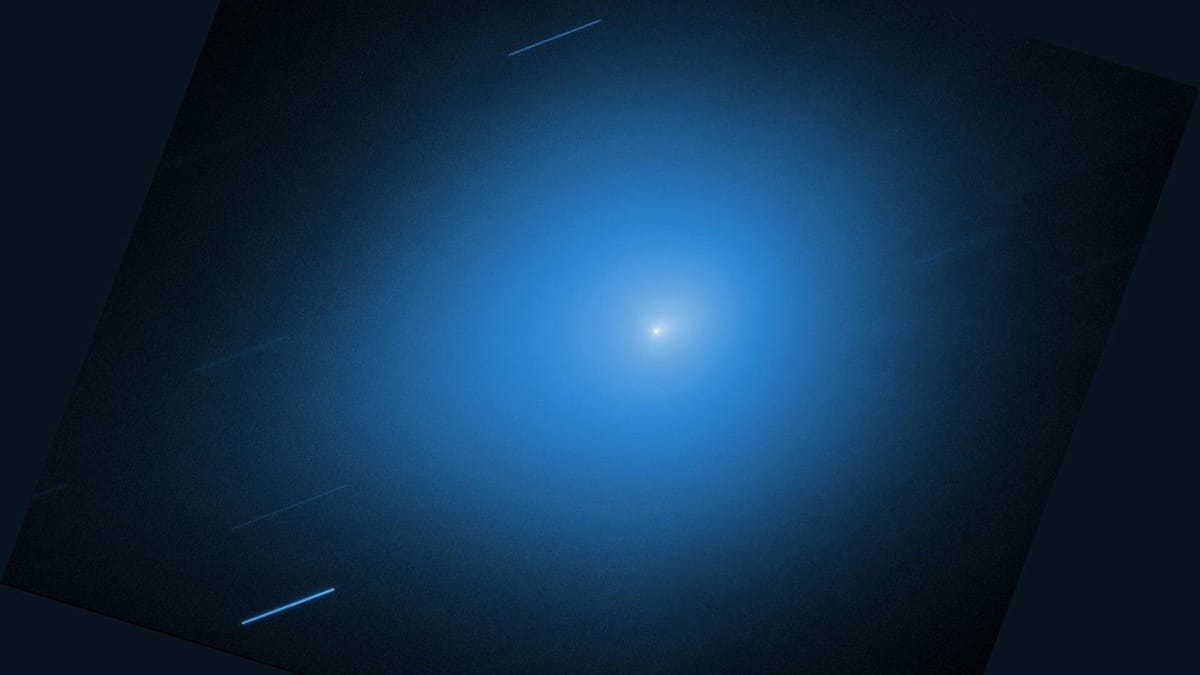
On December 19, 2025, the interstellar comet designated 3I/ATLAS passed within a few million kilometers of Earth, offering a brief window for both professional astronomers and amateur skywatchers to observe the object. The close approach occurred in the early hours of UTC, and the comet was visible to the naked eye under dark skies, prompting a surge of interest on social media and in observatories worldwide.
Discovered earlier this year by a survey telescope in Chile, 3I/ATLAS is the third known object to originate outside the Solar System. Its hyperbolic trajectory indicates a speed of roughly 60 km/s relative to the Sun, and its perihelion distance placed it just beyond the orbit of Venus. At its closest point to Earth, the comet was estimated to be about 0.03 astronomical units away, roughly twelve times the distance between the Earth and the Moon.
High‑resolution imaging was captured by the Gemini Multi‑Object Spectrograph (GMOS) on the Gemini North telescope in Hawaii, revealing a bright nucleus surrounded by a faint, elongated tail composed of dust and volatile gases. Simultaneous observations were conducted by several ground‑based facilities, including the European Southern Observatory and the Mauna Kea Infrared Observatory, as well as space‑based assets such as the Hubble Space Telescope. Early spectroscopic data suggest the presence of water ice, carbon monoxide, and complex organic molecules, providing a rare glimpse into the chemical makeup of material formed around another star.
The appearance of 3I/ATLAS follows the detections of the interstellar visitors ʻOumuamua in 2017 and comet 2I/Borisov in 2019, events that have reshaped scientific understanding of planetary system formation. Researchers note that each new interstellar object offers an opportunity to test models of stellar ejection mechanisms and to compare the composition of extrasolar matter with that of comets native to our own Solar System.
Officials from the international space community emphasized the importance of rapid response to such fleeting events, noting that coordinated observations across multiple wavelengths are essential for extracting maximal scientific value. Astronomers expect the comet to continue receding from the Sun over the coming weeks, becoming too faint for detailed study after early January. Nevertheless, data collected during the close approach will be analyzed for months, contributing to ongoing research into the origins and diversity of planetary systems beyond our own.